
Ancient and veteran trees
We are currently surveying and identifying ancient and veteran trees in Buckinghamshire and Milton Keynes so that we can better protect them.
Types of tree
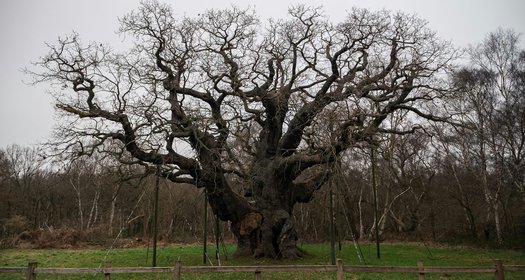
Veteran tree: A tree of biological, aesthetic, or cultural interest because of its size, age and condition; containing some ancient characteristics.
Ancient tree: A tree which has passed beyond maturity and is old in comparison to other trees within the same species.
Some people use the chronological ages of the trees to define an ancient tree, as an ancient tree is a tree that has reached a great age in comparison with others of the same species.
For example, a Birch tree can be considered ancient at the age of 150 years, whereas an Oak tree is not considered ancient until it is at least 400 years old.
The age of the tree can be difficult to estimate, therefore considering the ancient characteristics of the tree can also be a useful method to determine whether a tree is ancient or veteran.
Identifying an ancient or veteran tree
Veteran trees are in their mature stages of life, generally being older trees. All ancient trees will be veteran but not all veteran trees can be ancient. There is potential overlapping of classification for an individual tree.
Both veteran and ancient trees can show ancient characteristics, such as:
- water holes or pockets
- hollowing
- large girth in comparison with its species
- epicormics growth
- tears or scars
- evidence of decay and rot
- cavities
- the crown has retrenched through age
- wide trunk
- an "old" aesthetic appeal
- dead wood
The more characteristics the tree has, the more likely it is to be ancient.
View a guide to identifying trees of special interest
The Ancient Tree Forum have produced a guide to help people recognise trees that have special interest and to help justify why a tree (or group of trees) stands out from others of the same species.
Importance of ancient and veteran trees
In many parts of the world, ancient and veteran trees have become very rare. There are some still left in the UK, but they are struggling to survive with the present threats.
To conserve and protect these special trees of interest, we need to record them to ensure the continuity of the ancient tree populations and for people to understand their value.
Ancient and veteran trees are important:
Ancient and veteran trees provide a valuable habitat to wildlife.
This special habitat may take several centuries to become a suitable home for many rare invertebrates and fungi, developing complex inter-relationships.
Veteran trees are an essential food resource. Invertebrates associated with decaying wood become food themselves for mammals and birds.
It is therefore vital to conserve these trees.
Trees can also have heritage value, as part of our history and culture.
Over the many years we have connected with certain trees that appeal to us because of their:
- character
- aesthetic appearance
- landscape setting
- botanical interest.
Trees can also have significant cultural importance, such as old parish boundary markers.
Threats to trees
Threats to ancient and veteran trees include:
Traditional practices are becoming lost in communication. Potential bad practice can lead to them being cut harshly or cut down completely.
Knowledge of maintaining a traditional pollard or coppice is vanishing. The result can be serious damage or death of these trees.
Pressures are rising for increased food production and infrastructure development to accommodate the increasing population.
This causes stress on the tree roots as farmers are cultivating and buildings are planned too close to them.
There are many threats to trees, such as Sudden Oak Death or the recent cases of Ash dieback.
Tell us about an ancient or veteran tree
If you know of any trees of special interest with ancient characteristics within Buckinghamshire and you would like to be included in our records, contact us.
Send us your name, contact details and the date you saw the tree. In addition we need a location (preferably a 6 figure grid reference).
The following information is also helpful:
- owner of the land
- is the tree accessible to the public (Yes or no)
- species
- characteristics of the tree
- habitat (for example: garden, fields)
- management (for example: low or high intensity, pruning)
- photographs of the tree
You can also download and use the Trees of Interest Recording Form (DOCX, 32KB) and email this to us at erc@buckinghamshire.gov.uk.
To request this Recording Form in a different format, or if you would like more information about this project, please contact us.